Guide • 6 min read •
Polyhedral Dice Types Explained - Platonic Solids and Beyond
From ancient Mesopotamia to modern digital tabletop tools, discover the mathematical beauty of polyhedral solids and how their geometric symmetries ensure fair, unbiased probability.
Geometric Symmetry: What Makes a Die Fair?
A die is mathematically isohedral (fair) if its symmetry group acts transitively on its faces—meaning every face is geometrically congruent and equidistant from the center of gravity.
The five **Platonic solids** are the only regular convex polyhedra where all faces are identical regular polygons and identical numbers of faces meet at each vertex:
- **Tetrahedron** (4 faces - D4)
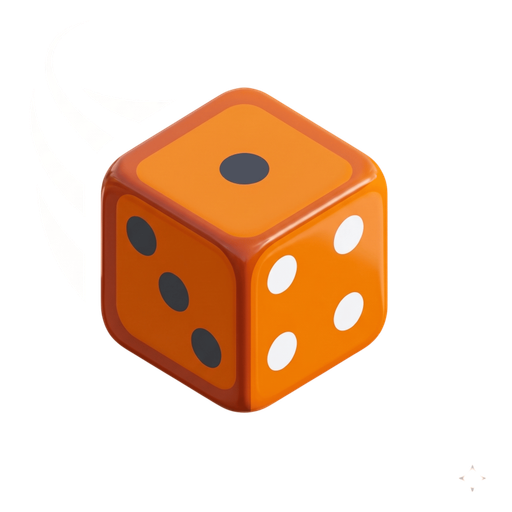
- **Hexahedron** (6 faces - D6)
- **Octahedron** (8 faces - D8)
- **Dodecahedron** (12 faces - D12)
- **Icosahedron** (20 faces - D20)
Non-Platonic Dice: The D10 and D100
There is no Platonic solid with 10 faces. The **D10** is instead a **pentagonal trapezohedron** (a Catalan solid). Its 10 kite-shaped faces are congruent and symmetrical, making it completely fair even though its faces are not equilateral polygons.
The **D100** physical die (Zocchihedron) is a sphere with 100 flattened facets, often packed with internal weights or braking fluid to keep it from rolling endlessly across the room.
Virtual Dice vs Physical Dice
Physical dice can suffer from micro-imperfections: air bubbles inside resin, rounded edges from tumbling polishing barrels, or uneven paint fill.
Digital dice rollers eliminate physical manufacturing flaws by utilizing cryptographic pseudo-random number generators (CSPRNG) with rejection sampling, guaranteeing uniform mathematical distribution across all faces.
Ready to test these rolls?
Use our online dice calculator with exact probabilities and roll history.
Guide FAQ
How many Platonic solids exist in geometry?
There are exactly five Platonic solids: tetrahedron (4), cube (6), octahedron (8), dodecahedron (12), and icosahedron (20).
Why is there no 10-sided Platonic solid?
Euclid proved in the Elements that only five regular convex polyhedra can exist in three dimensions. A 10-sided die must use kite faces (trapezohedron) rather than regular polygons.